$ cd /projects/betsquid
betsquid.com — Automated Horse Racing Betting System
GitHub: private (646 commits, Rails 4.2/JRuby)
PRE — Idea · Setup · Build
Goal: Build an automated betting system that exploits
statistical patterns in UK horse racing markets. Not gambling.
Algorithmic trading on betting exchanges.

A friend came up with the core idea and an algorithm: a
recovery-based betting strategy where the statistical
probability of winning within 9 consecutive races was high
enough to be profitable. If you lose, you re-bet with
adjusted stakes to recover the loss in the next race. The
math said it worked. The math was mostly right.

I was the engineer. He was the domain expert. The plan:
build the platform, prove the algorithm, find investors,
scale it, maybe sell it to a Malta-based betting company.

I coded the entire thing while traveling for freelance work.
In a comfy lounge chair in a hotel lobby, sipping on a glass
of white wine. The algorithm variants were named during late-
night brainstorming sessions: Kermit, Topcat,
John, Kylie, Steve, Britney, Bob. Each one a different
tuning of the same core strategy. I have no idea which ones
were named after real people and which ones were just funny
at 11pm with a whisky.

Stack:
  - Ruby on Rails 4.2 on JRuby 9.0.5.0
  - MySQL database (34MB+ of race data)
  - Betfair REST API (primary exchange)
  - BetDAQ SOAP/XML API (secondary exchange)
  - Sidekiq for background job processing
  - Clockwork scheduler for automated daily runs
  - Puma application server
  - PayPal Recurring for subscription billing
  - Gruff for odds history graph generation
  - Capistrano for deployment
  - 643MB of historical odds graphs
  - Certificate-based Betfair authentication
The Algorithm
The system wasn't picking winners. It was detecting market
movement and exploiting price inefficiencies.

THE CORE: STEAM DETECTION

A "steam" in betting markets is a rapid odds drop —
the price collapses because informed money is flooding in
before a race. The system watched for these patterns:

  1. Pull today's UK races from Betfair at 11:00am
  2. Track odds movements from 10:30am (when racing info
     drops and the market starts moving)
  3. Identify "steam" candidates — horses with starting
     odds < 3.75 whose price is dropping rapidly
  4. Place a BACK bet at the steamed-down price
  5. Wait for DRIFT (price recovery)
  6. Place a LAY bet to lock in profit regardless of the
     actual race outcome

Back low, lay high. The spread is profit. The race result
is irrelevant if both legs execute.

THE BRAIN: STEAMYBRAIN (476 lines)

The algorithm engine that built the complete Betfair odds
ladder (1.01 to 10.0, with varying tick sizes per range),
defined steam thresholds for every starting price bracket,
and configured drift tolerances. Every price range had its
own entry/exit parameters. Deeply tuned. Multiple config
versions for A/B testing different strategies.

THE EXECUTOR: KERMIT (279 lines)

The back-and-lay arbitrage engine. Places the BACK bet when
steam is detected. Monitors for drift. Places the LAY bet
when recovery begins. Aborts if the price crashes below the
floor. Operates in a 3-minute pre-race window. Calculates
lay stakes dynamically based on the back entry price.

THE BACKTESTER: STEAMWORKS (215 lines)

Monte Carlo-style simulation engine. Replayed millions of
historical bets across years of data. Tweakable parameters
for sensitivity, entry thresholds, drift tolerance. Generated
CSV reports and P&L curves. This was the R&D lab where
strategies were born and killed.

All of this — built without AI, without machine learning
libraries, without Python notebooks. Pure Ruby, pure logic,
pure pattern recognition. Data crunching across millions of
records from the comfort of a hotel lobby.
The Cross-Exchange Play
The system tracked both Betfair and BetDAQ simultaneously.
Same races, same horses, different odds.

A "Supermatch" model handled identity reconciliation across
exchanges — matching the same horse in the same race on
both platforms. This enabled cross-exchange arbitrage: back
at one exchange, lay at the other, guaranteed profit from the
price difference.

The BetDAQ integration used SOAP/XML (because of course it
did — this was the era). The Betfair integration used
REST with SSL certificate authentication. Both APIs polled
every 10 seconds during active racing. Sidekiq workers
processed candidates in parallel.
The Business Model
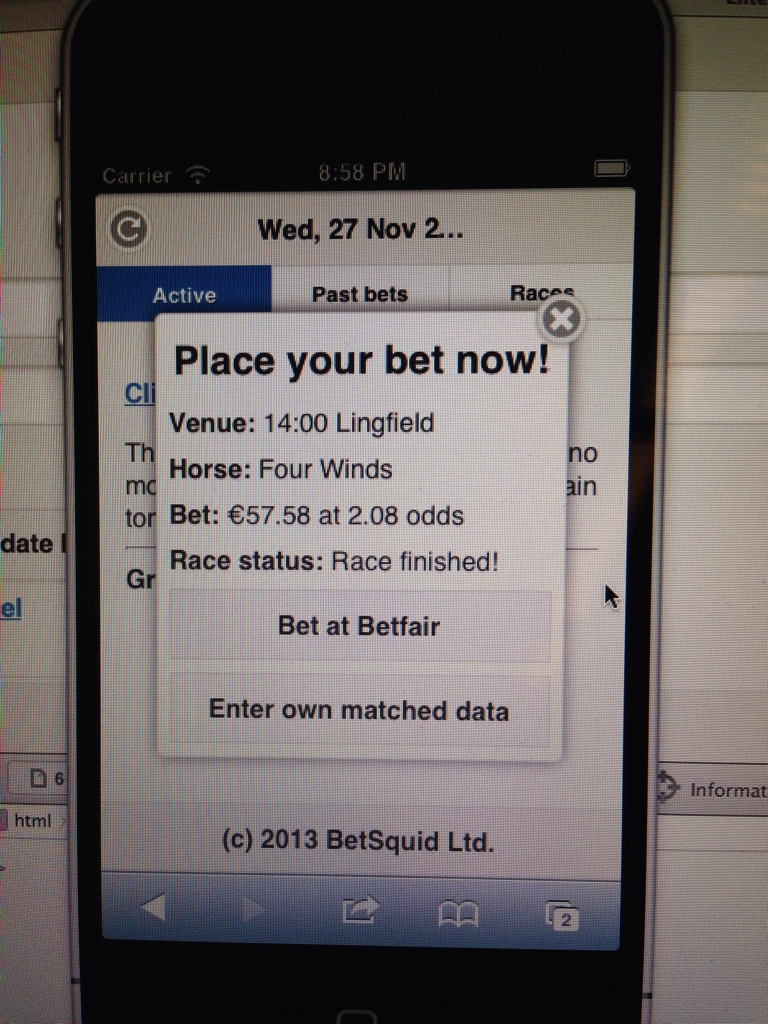
BetSquid was designed as a subscription product:

  - Web dashboard with real-time odds updates
  - Historical performance graphs per runner per market
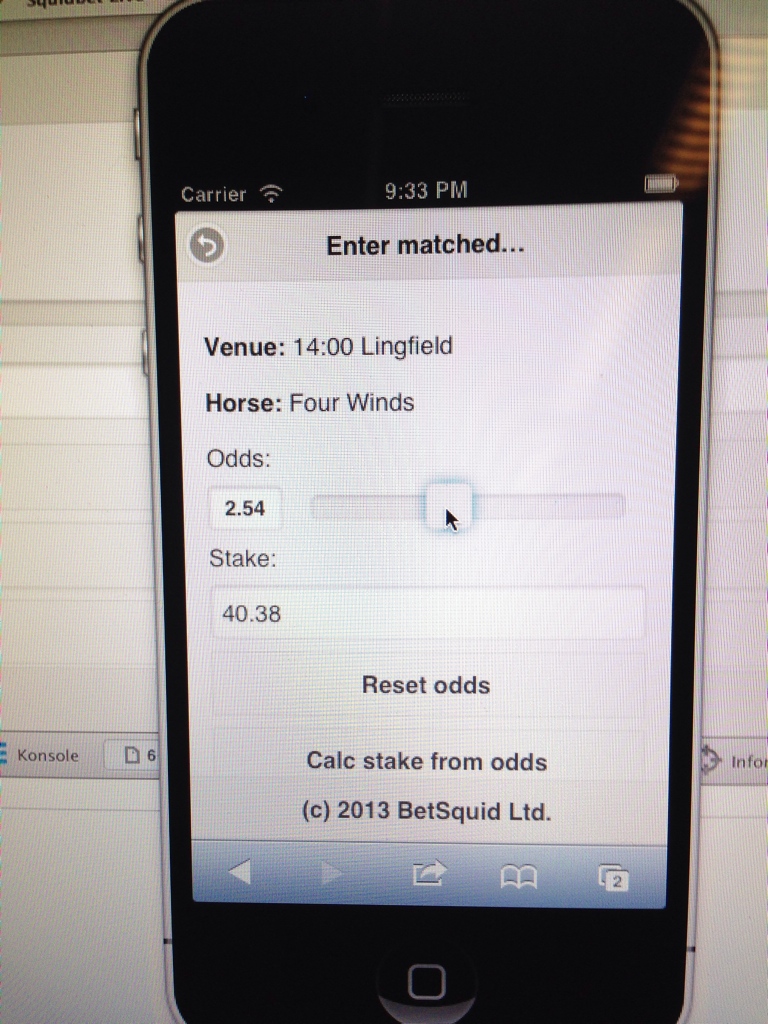
  - Manual bet placement and automated execution modes
  - Tiered plans: Basic (view only) and Pro (autobet)
  - PayPal recurring billing
  - Tiered betting days: bt1 through bt5, with daily loss
    limits and state machine progression

The idea was: prove the algorithm, show the P&L charts,
sell subscriptions to punters who want to automate their
betting. My partner built presentations. Designed a cool
logo. Approached Malta-based betting companies. We had big
goals.

Nobody invested. Nobody subscribed. The product was built.
The marketing never happened. Classic Dan: "you gotta have
the product first." So I built it. All 646 commits of it.
And we never sold it.
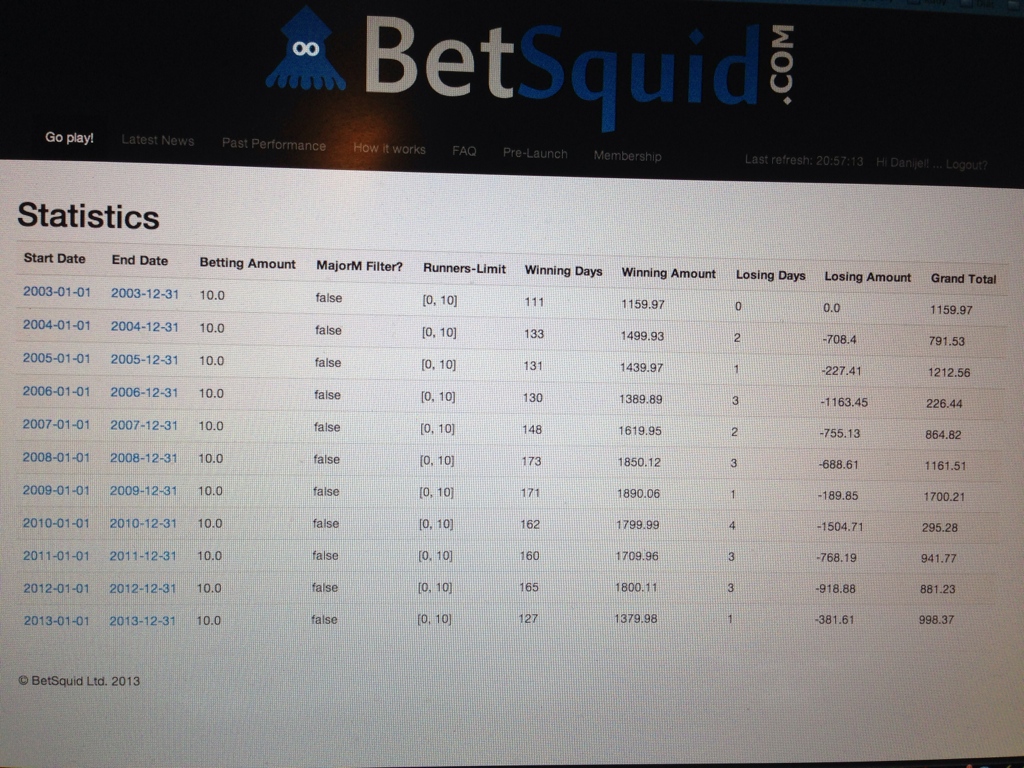
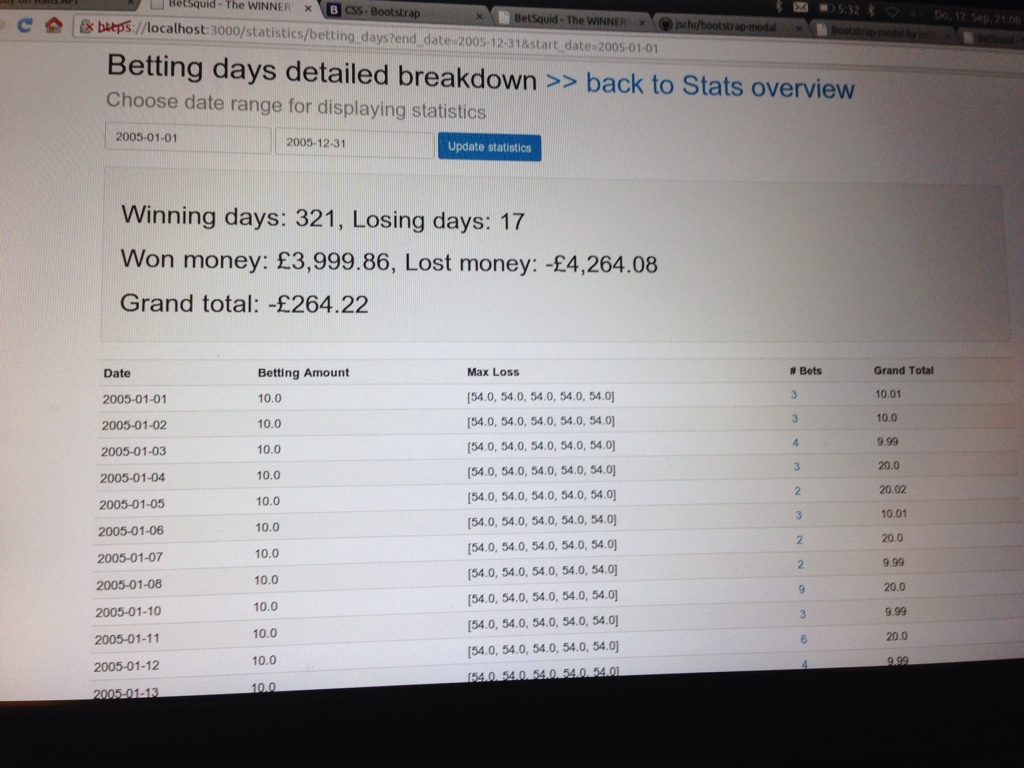
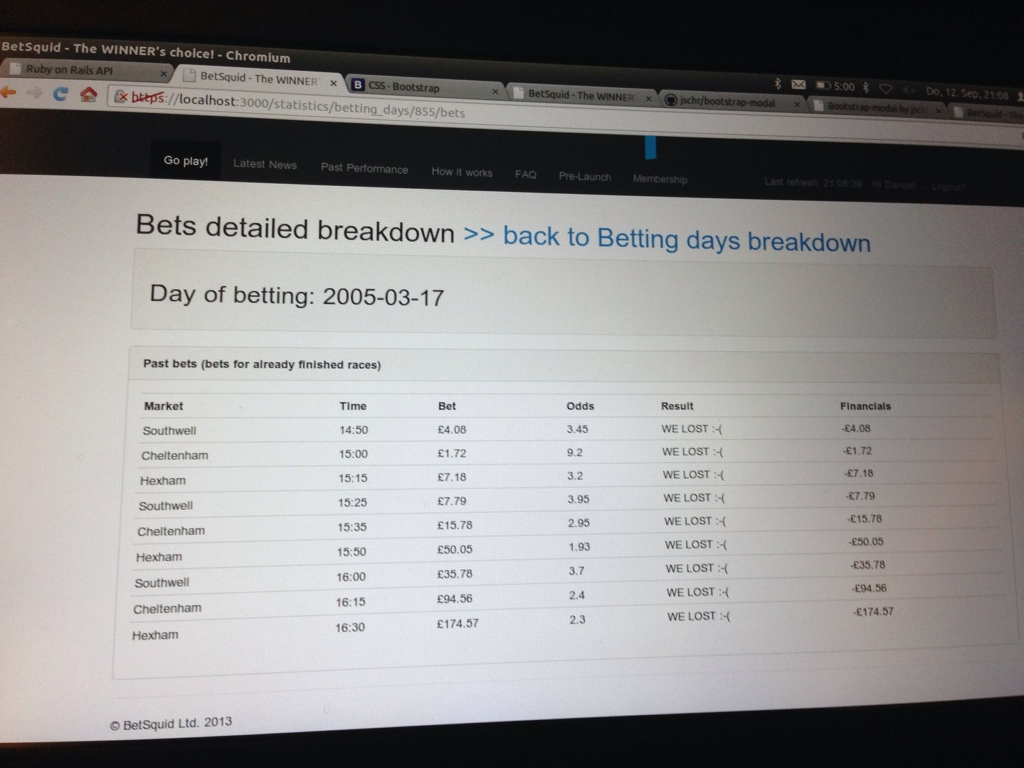
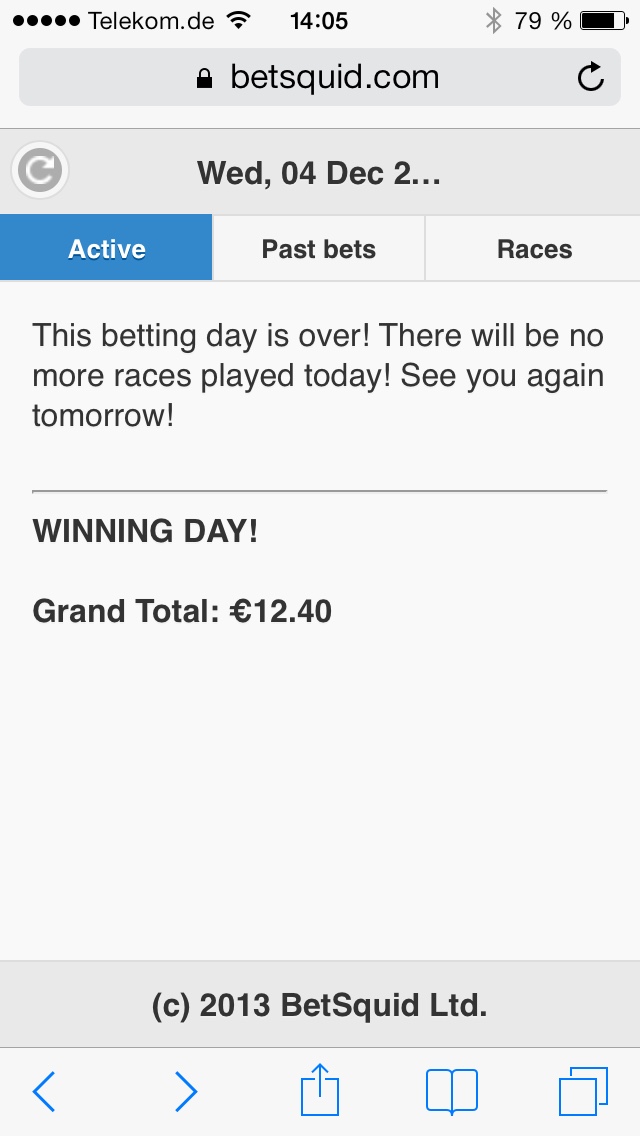
Screenshots — The Dashboard & The Data
POST — Learnings · Afterthoughts · Timeline
What happened:

It worked. Until it didn't.

The algorithm was sound in backtesting. The Monte Carlo
simulations showed consistent profitability across years of
historical data. Live trading confirmed it — for a while.
Money was being made. The math was holding.

Then the edge cases arrived. Markets are manipulated. Weather
changes cause unpredictable results (a muddy track in
Cheltenham rewrites every probability). The recovery strategy
that "statistically guaranteed" a win within 9 races hit
streaks that the statistics said were improbable but the
universe didn't care about statistics.

The investor search went nowhere. Malta betting companies
weren't interested. The presentation deck gathered dust. And
eventually, like every pattern in this archive, the energy
moved elsewhere.

But the data crunching — millions of bets analyzed for
patterns, Monte Carlo simulations across years of historical
data, odds ladder construction, cross-exchange arbitrage logic
— all of that was built by one person in Ruby, without
AI, without ML frameworks, without anything except logic and
persistence and whisky. That counts for something.

Learnings:

  - Algorithmic betting on exchanges is algorithmic trading
    with worse infrastructure and better stories. The math is
    the same. The domain knowledge required is immense.

  - Backtesting is seductive and dangerous. A system that shows
    consistent profit across 5 years of historical data can
    still blow up in month 6 of live trading. The market adapts.
    The weather doesn't cooperate. The tail events arrive.

  - Recovery-based betting strategies (martingale variants) work
    brilliantly until they don't. The statistical probability
    of winning within N races is high. But "high probability"
    is not "certainty," and when the streak hits, the losses
    compound exactly as fast as the strategy assumed they
    wouldn't.

  - 646 commits over 5.5 years, coded in hotel lobbies across
    Europe during freelance travel, is either the most dedicated
    or the most portable development process imaginable. Probably
    both.

  - The algorithm names — Kermit, Topcat, John, Kylie,
    Steve, Britney, Bob — are a testament to late-night engineering decisions.
    Some of the best code is written in the worst conditions.

  - "Build it and they will come" continues to be the most
    persistent and most wrong assumption in my career. Nobody
    comes. You have to go get them. Marketing is always the
    bottleneck. Always.

  - The cross-exchange arbitrage concept (back at Betfair, lay
    at BetDAQ) was genuinely clever. Two different markets,
    same event, guaranteed spread. The execution was the hard
    part — latency, liquidity, odds ladder alignment.

Timeline:
  - 31 Jul 2013: First commit. The journey begins.
  - 2013-2014: Core platform built. Betfair + BetDAQ APIs
    integrated. Steam detection algorithm developed. 34MB of
    race data accumulated. Coded in hotel lobbies across Europe.
  - 2014-2015: Cross-exchange matching ("Supermatch"). PayPal
    billing. Tiered betting days. Compound betting logic.
    Live product running with real money.
  - 2015-2017: Backtesting engine (SteamWorks). Monte Carlo
    simulations across millions of historical bets. Algorithm
    variants tested: Topcat, John, Kylie, Steve, Britney, Bob.
  - 2018: Kermit (back-and-lay arbitrage engine). SuperKermit.
    SteamBomb workers for distributed processing. The most
    sophisticated version of the system.
  - Feb 2019: Final commit ("lay works"). Development stops.
  - 643MB of historical odds graphs. 34MB+ of race data.
    Millions of simulated bets. Zero paying customers.

Status: Complete. 646 commits of algorithmic betting infrastructure,
  built in hotel lobbies across Europe between freelance gigs. The
  steam detection algorithm worked. The backtesting infrastructure
  is production-quality. The market timing and marketing didn't
  align. The engineering did.